Across Southeast Asia, a new race is underway. Countries are competing to attract investments from hyperscale cloud providers, AI platforms, and digital infrastructure operators that will underpin the next generation of economic growth. Thailand has emerged as one of the strongest contenders in this race. Its strategic location at the heart of ASEAN, well-developed telecommunications infrastructure, growing digital economy, and supportive investment policies have attracted increasing interest from global technology companies and infrastructure investors. As cloud adoption accelerates and AI becomes an essential component of modern business operations, demand for digital infrastructure continues to grow at an unprecedented pace.
The scale of digital infrastructure investment application as reference from BOI reflects strong confidence in Thailand's future role within the regional digital economy. However, becoming a successful sustainable digital hub for future requires more than infrastructure or investment incentives.
Mr. Teerapan Luengnaruemitchai, Managing Director of TCC Technology (TCCtech) stated “The scale of digital infrastructure investment we are seeing today demonstrates strong confidence in the country's potential. However, infrastructure alone will not determine long-term success. A country's ability to sustain long-term competitive advantage depends on its capacity to build ecosystems where businesses, technology, and innovation can thrive together.”
As Thailand enters the next phase of digital infrastructure development, the conversation is shifting to how effectively Thailand can connect the businesses, platforms, and people that depend on them.
At the heart of that conversation is Connectivity.
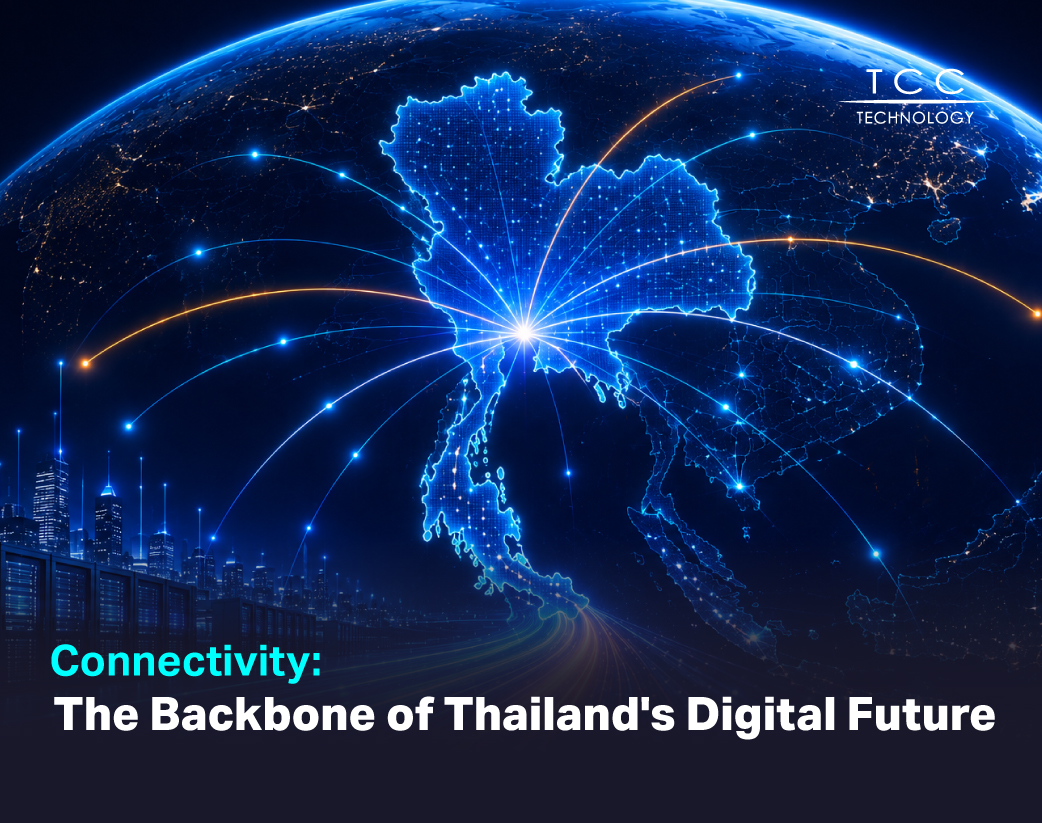
Connectivity: The Foundation Beneath the Digital Economy
Connectivity is often discussed as a technical topic, yet its impact extends far beyond networks and infrastructure. In reality, connectivity has become one of the most important enablers of economic competitiveness in the digital era. Every digital interaction depends on connectivity. When consumers stream content, conduct financial transactions, access cloud applications, engage in e-commerce, or interact with AI-powered services, data flows across multiple networks, platforms, and service providers before reaching its destination. The speed, resilience, and efficiency of those connections directly impact business performance and customer experience.
While platforms process information, connectivity enables information to move among users, businesses, applications, and digital services. Without strong interconnection, digital infrastructure remains fragmented. With it, digital ecosystems can flourish.
This is why the world's most successful digital economies have invested heavily in dense interconnection environments. Markets such as Singapore, Amsterdam, and Frankfurt became global digital hubs not only because of their infrastructure investments, but because they successfully created ecosystems where cloud providers, network operators, internet exchanges, content platforms, enterprises, and digital service providers can efficiently exchange data and services.
The value of connectivity extends beyond technology. Strong interconnection environments lower barriers for organizations seeking to enter new markets by providing immediate access to established networks, partners, and customers. As enterprises increasingly operate across cloud platforms, digital channels, and international markets, connectivity is no longer viewed as a utility. It is increasingly recognized as a strategic business asset.
The Power of Ecosystems
If Connectivity is the foundation of a digital economy, then ecosystems are like the engines that create value from that connectivity. Based on the PeeringDB.com data, TCCtech stands out as one of Thailand’s strongest interconnection partners, making it an ideal choice for any provider seeking high‑performance, resilient, and scalable digital infrastructure. With 55 networks hosted at BNDC, it maintains one of the largest and most diverse peering ecosystems in the country, bringing together global CDNs and major Thai ISPs. This diversity enables providers to benefit from lower latency, richer routing paths, and improved redundancy. TCCtech is also among the most interconnected centers in Thailand, with direct access to 8 major IXPs such as BKNIX, giving providers unparalleled reach across domestic and regional networks.
Furthermore, TCCtech’s ecosystem includes international, extending its footprint into the broader ASEAN and global markets. PeeringDB also highlights BNDC as one of Thailand’s "leading Carrier Neutral Hub," attracting networks that value open access and flexibility. TCCtech also operates multiple ASNs, demonstrating depth in international transit, domestic interconnection, and ISP operations. Its presence across multiple peering facilities, reinforces its strong national footprint. The fact that high‑value networks and CDNs peer at TCCtech facilities further validates its capability to meet global‑grade requirements for performance, uptime, and scalability. Altogether, TCCtech offers providers a strategic, high‑performance, and future‑ready interconnection environment, making it a top choice for delivering low‑latency services, improving network reach, and supporting regional digital growth.
TCCtech serves as a strategic gateway for multinational businesses establishing, expanding, or managing operations across Thailand and ASEAN through its robust digital ecosystem. The significance of this ecosystem lies not merely in its scale, but in its diversity. Organizations within the TCCtech ecosystem gain access to telecommunications carriers, internet service providers, cloud platforms, content providers, internet exchanges, multinational corporations, technology partners, and enterprise customers. These participants represent industries ranging from banking, insurance, manufacturing, and logistics to telecommunications, real estate, retail, and digital services.
This ecosystem creates a powerful network effect. As more participants join, value increases for every connected organization through greater connectivity options, stronger resilience, richer routing diversity, and broader access to customers and partners.
For multinational corporations entering Thailand, such an ecosystem significantly reduces the complexity and time required to establish digital operations and connect with local and regional markets.
National Digital Connectivity Infrastructure
TCCtech's contribution to Thailand's digital ecosystem extends further as one of Thailand's licensed International Internet Gateway (IIG) and National Internet Exchange (NIX) operators regulated by the National Broadcasting and Telecommunications Commission (NBTC). This enables TCCtech to play a strategic role in facilitating both domestic and international internet traffic exchange while supporting connectivity among networks, content providers, cloud platforms, and enterprises. Its International Internet Gateway (IIG) services provide high-capacity international bandwidth and global routing capabilities, enabling organizations to access regional and international markets through reliable cross-border connectivity. Its National Internet Exchange (NIX) services support efficient domestic traffic exchange among local ISPs, content providers, and enterprise networks, improving performance while strengthening Thailand's internet infrastructure. TCCtech also operates the Bangkok Gigabit Ring (BKK Ring), a high-speed fibre-optic infrastructure that interconnects key business districts, commercial centers, office buildings, and digital infrastructure locations throughout Bangkok. This provides enterprises with enhanced connectivity choices, route diversity, and business continuity options. Beyond Thailand, the company supports regional connectivity through terrestrial fibre corridors extending to major ASEAN markets. These regional routes further strengthen Thailand's role as a gateway for cross-border digital business and data exchange. Together, its facility, IIG, NIX, BKK Ring, and regional connectivity assets position TCCtech as more than a connectivity provider. They establish the company as a key enabler of Thailand's digital infrastructure ecosystem and a bridge connecting Thailand to the broader ASEAN and global digital economies.
From Connectivity Hub to Trusted Technology Solutions Partner
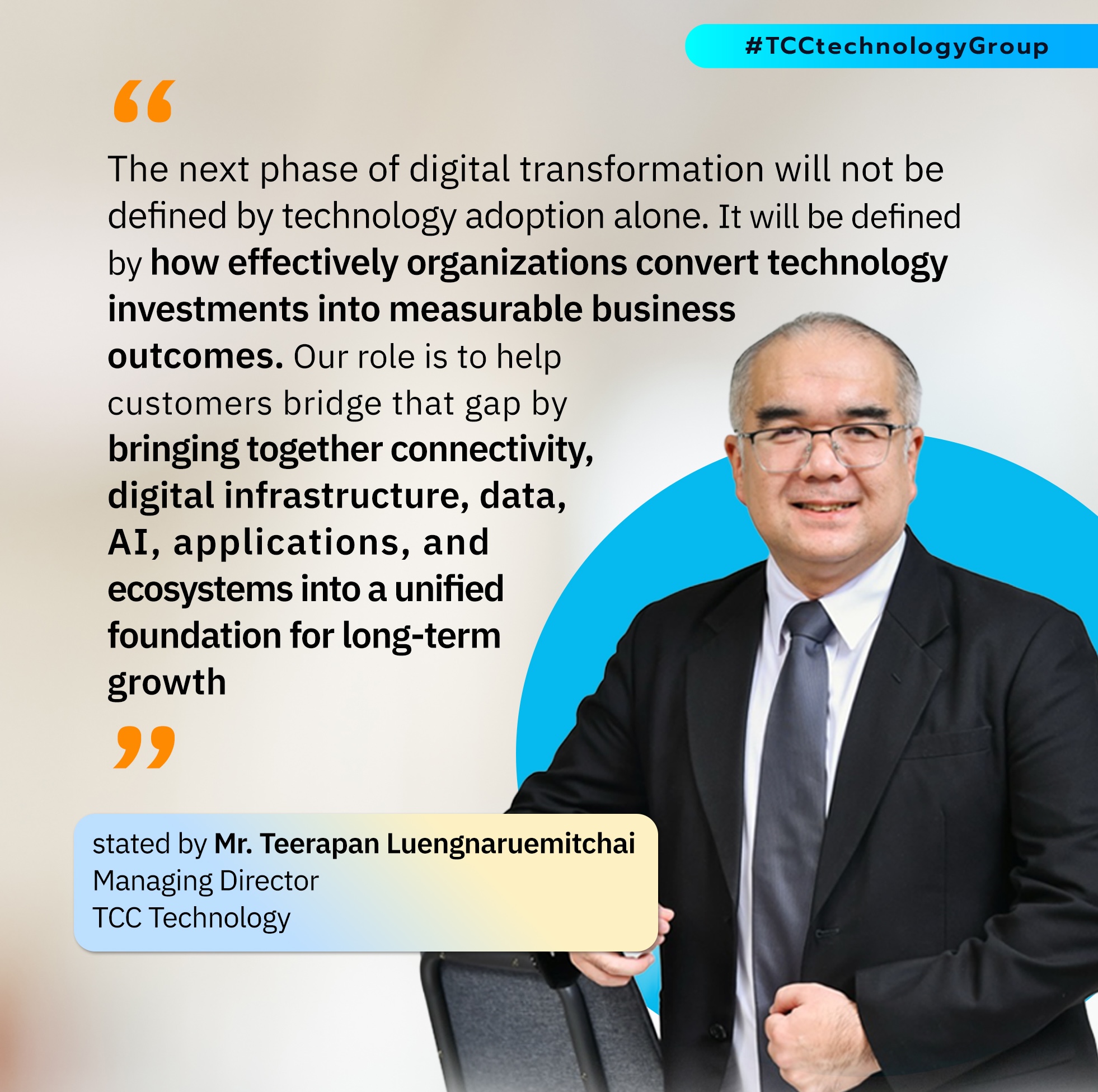
Artificial Intelligence has become a boardroom priority across industries. However, successful AI adoption requires far more than simply deploying AI applications. Organizations must establish robust data foundations, governance frameworks, scalable infrastructure, and integrated business processes to unlock sustainable business value. This is where TCCtech differentiates itself. Rather than focusing on individual technology solutions, TCCtech brings together infrastructure, connectivity, data, AI, applications, and business ecosystems into a unified framework that enables organizations to accelerate digital transformation, drive operational excellence, and innovate with confidence.
TCCtech supports customers in building AI-ready environments that enable predictive analytics, intelligent automation, advanced decision-making, and operational optimization. With a strategic focus on the PropTech and ManuTech communities. In the property sector, TCCtech enables Smart Property initiatives through intelligent building platforms, IoT integration, energy management, digital tenant services, and smart facility management solutions. For manufacturers, the company supports digital transformation through industrial connectivity, real-time production monitoring, OT/IT integration, predictive maintenance, manufacturing analytics, supply chain visibility, and AI-driven operational insights, helping enterprises improve efficiency, resilience, and competitiveness in an increasingly data-driven economy.
Looking Ahead
As the country strengthens its position within the regional digital economy, the organizations that can connect businesses, platforms, and innovation at scale will play an increasingly important role. In that environment, TCC Technology's vision extends beyond operating infrastructure. It is about enabling a connected digital ecosystem that helps local enterprises, multinational corporations, and industries unlock new opportunities for growth, innovation, and long-term competitiveness across Thailand and ASEAN.
Key Takeaways
- Thailand's Digital Potential: Driving Sustainable Growth
- Connectivity Is the Foundation of the Digital Economy
- Ecosystems Drive Digital Growth
- The Future is About Turning Technology into Business Outcomes







.jpg)